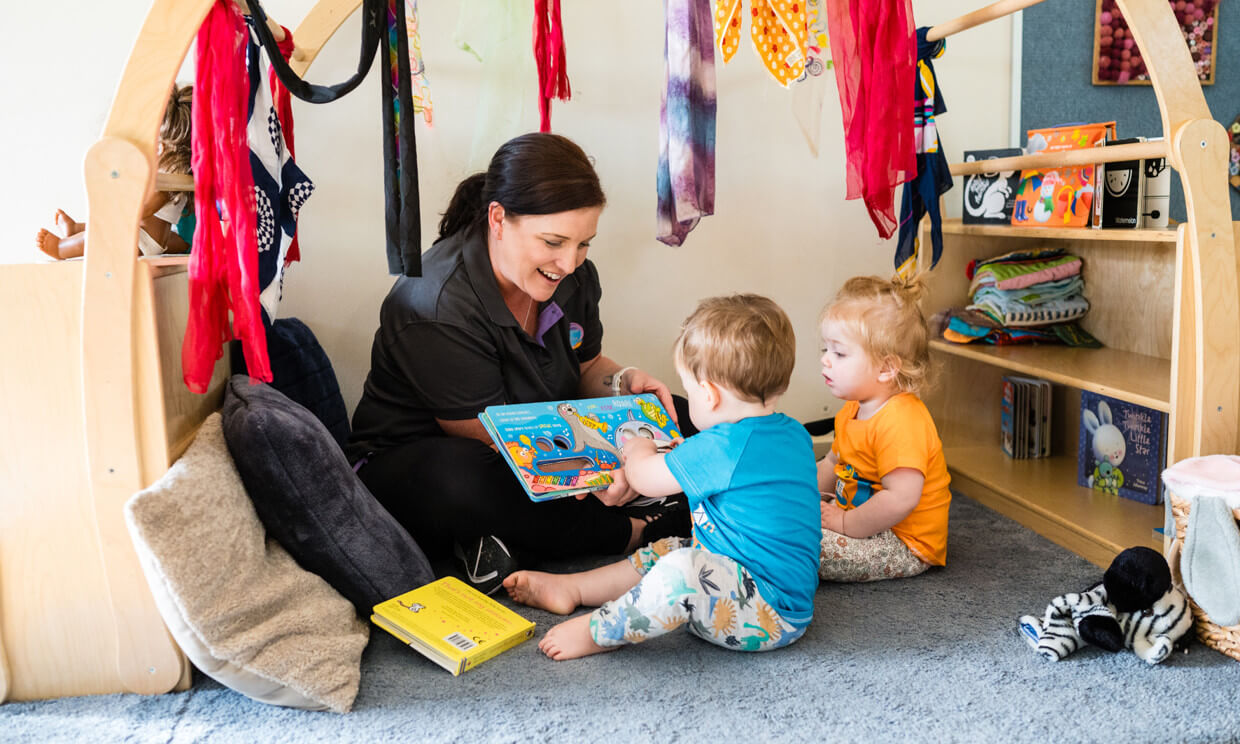
In Books, Toddlers and Language, I told you about how reading repetitive books with infants and toddlers can be a great way to entice them into using language with you. These books are great for any child and they can also be essential tools for helping children with diagnoses such as apraxia or autism.
Here, then, is a list of my favorite repetitive books. Is one missing? E-mail us at [email protected] and share it. We’ll add it to the list. Happy Reading!
Brown Bear by Bill Martin Jr. and Eric Carle
Polar Bear by Bill Martin Jr. and Eric Carle
The Very Hungry Caterpillar, by Eric Carle
Chugga Chugga Choo Choo by Kevin Lewis
Tugga Tugga Tug Boat by Kevin Lewis
Good Night Moon by Margaret Wise Brown
Blue Hat, Green Hat by Sandra Boynton
Doggies by Sandra Boynton
5 Little Monkeys Jumping On The Bed by Eileen Christelow
This time around, I”m pulling out a couple more indirect language facilitation strategies that parents can put in their language-boosting tool box: expansion and extension. These both fall under the category of “indirect language facilitation” because they are built around a child’s utterance (what the child says) and because they do not require a response from the child. This differs from strategies that are based on the principles of applied behavioral analysis (ABA). ABA techniques usually involve a specific, targeted response from the child that is prompted or elicited, required, and reinforced. (As a slight aside, I certainly think that both child-directed/indirect language facilitation techniques AND clinician-directed/ABA strategies can be- and often should be – used together. And, there is a time and a place where each is more effective than the other. But that’s a different post all together).
Expansion and extension are very similar. The most important part of these techniques is that the parent uses them to respond to the child. This requires that a child initiate (start) an interaction somehow. The child might point, or vocalize, or say a word …. anything that starts an interaction. Then a parent either expands on or extends what the child has to say.
In my experience in working with parents, the hardest part about these strategies is that they require parents to wait. Often, when we are in teaching mode, we are inclined to instruct- to direct a child, to tell a child what to do or how to do it. Again, there is most definitely a place for this (heaven knows I have directed many children to do many things in my career). There also need to be times, however, when we respond to a child’s language instead of directing it. And that’s where expansion and extension come in.
So how are they different? When we EXPAND a child’s utterance, we keep the child’s word order the same and expand it just slightly to make it a bit longer and/or more grammatically correct. When we EXTEND a child’s utterance, we simply respond to the child’s utterance in a conversational way, providing a bit of new information that is related to what the child had to say.
So, if a child says, “Puppy outside….”
We can expand this utterance by saying, “Puppy IS outside”. We’ve expanded because we’ve kept his word order the same (puppy is the first word, outside is the second- and we haven’t changed this), but we’ve made it just a bit longer (in this case we made it just one word longer) and more grammatically correct (in this case we add in the ‘contractible copula’ grammatical morpheme- the fancy word for is). I coach parents to expand their child’s utterance just by just one or two words. This makes the newly expanded phrase a perfect match for the child – it’s not too simple because it’s longer and more complex than what the child said, but it’s not so tough that it loses meaning for the child.
Back to the “Puppy outside” phrase. If we choose not to expand it…
We can extend this utterance instead by saying, “He’s barking.” In this case, we’ve responded to the child’s utteranceand we’ve stayed on the same topic (the puppy who is outside) but now we’ve added new information. We’ve extended the conversation by adding a bit more information. This is the key to extension.
Expansion and extension seem to work best with toddlers and young preschoolers, or children whose language levels match those of a typical toddler or young preschooler. These children often imitate the newly expanded or extended utterances, which we think helps them to grow their language. Plus, because we are responding to the child’s lead, we are tapping into whatever is interesting to the child at the moment, making our input (the language they hear) that much more salient, or pronounced, so that children are that much more likely to learn from it.
Research seems to indicate that many children learn language faster when their parents use more conversational language-learning strategies like expansion and extension, as compared to parents who are more directive with their children. And use of these techniques is also linked to longer utterances in children – in other words, children who are exposed to these types of responsive language facilitation techniques seem to use longer sentences overall. Seems like a good deal to me!