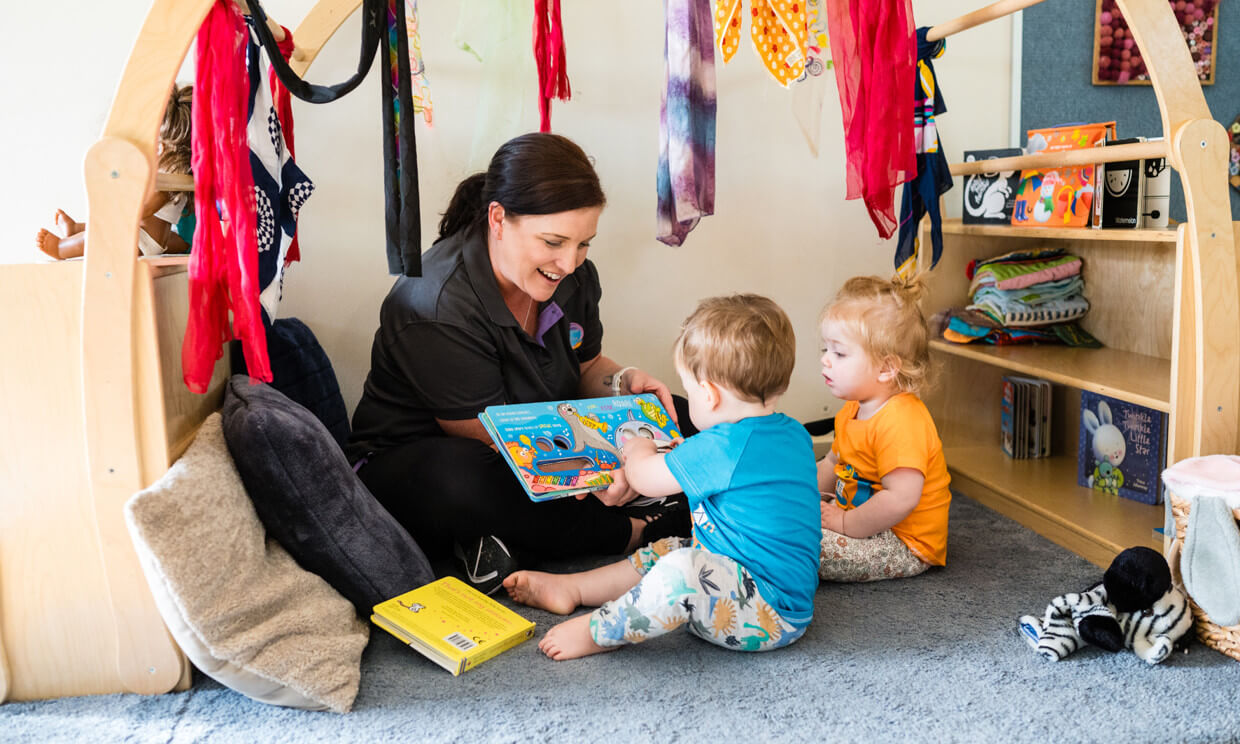
In Books, Toddlers and Language, I told you about how reading repetitive books with infants and toddlers can be a great way to entice them into using language with you. These books are great for any child and they can also be essential tools for helping children with diagnoses such as apraxia or autism.
Here, then, is a list of my favorite repetitive books. Is one missing? E-mail us at [email protected] and share it. We’ll add it to the list. Happy Reading!
Brown Bear by Bill Martin Jr. and Eric Carle
Polar Bear by Bill Martin Jr. and Eric Carle
The Very Hungry Caterpillar, by Eric Carle
Chugga Chugga Choo Choo by Kevin Lewis
Tugga Tugga Tug Boat by Kevin Lewis
Good Night Moon by Margaret Wise Brown
Blue Hat, Green Hat by Sandra Boynton
Doggies by Sandra Boynton
5 Little Monkeys Jumping On The Bed by Eileen Christelow
This time around, I”m pulling out a couple more indirect language facilitation strategies that parents can put in their language-boosting tool box: expansion and extension. These both fall under the category of “indirect language facilitation” because they are built around a child’s utterance (what the child says) and because they do not require a response from the child. This differs from strategies that are based on the principles of applied behavioral analysis (ABA). ABA techniques usually involve a specific, targeted response from the child that is prompted or elicited, required, and reinforced. (As a slight aside, I certainly think that both child-directed/indirect language facilitation techniques AND clinician-directed/ABA strategies can be- and often should be – used together. And, there is a time and a place where each is more effective than the other. But that’s a different post all together).
Expansion and extension are very similar. The most important part of these techniques is that the parent uses them to respond to the child. This requires that a child initiate (start) an interaction somehow. The child might point, or vocalize, or say a word …. anything that starts an interaction. Then a parent either expands on or extends what the child has to say.
In my experience in working with parents, the hardest part about these strategies is that they require parents to wait. Often, when we are in teaching mode, we are inclined to instruct- to direct a child, to tell a child what to do or how to do it. Again, there is most definitely a place for this (heaven knows I have directed many children to do many things in my career). There also need to be times, however, when we respond to a child’s language instead of directing it. And that’s where expansion and extension come in.
So how are they different? When we EXPAND a child’s utterance, we keep the child’s word order the same and expand it just slightly to make it a bit longer and/or more grammatically correct. When we EXTEND a child’s utterance, we simply respond to the child’s utterance in a conversational way, providing a bit of new information that is related to what the child had to say.
So, if a child says, “Puppy outside….”
We can expand this utterance by saying, “Puppy IS outside”. We’ve expanded because we’ve kept his word order the same (puppy is the first word, outside is the second- and we haven’t changed this), but we’ve made it just a bit longer (in this case we made it just one word longer) and more grammatically correct (in this case we add in the ‘contractible copula’ grammatical morpheme- the fancy word for is). I coach parents to expand their child’s utterance just by just one or two words. This makes the newly expanded phrase a perfect match for the child – it’s not too simple because it’s longer and more complex than what the child said, but it’s not so tough that it loses meaning for the child.
Back to the “Puppy outside” phrase. If we choose not to expand it…
We can extend this utterance instead by saying, “He’s barking.” In this case, we’ve responded to the child’s utteranceand we’ve stayed on the same topic (the puppy who is outside) but now we’ve added new information. We’ve extended the conversation by adding a bit more information. This is the key to extension.
Expansion and extension seem to work best with toddlers and young preschoolers, or children whose language levels match those of a typical toddler or young preschooler. These children often imitate the newly expanded or extended utterances, which we think helps them to grow their language. Plus, because we are responding to the child’s lead, we are tapping into whatever is interesting to the child at the moment, making our input (the language they hear) that much more salient, or pronounced, so that children are that much more likely to learn from it.
Research seems to indicate that many children learn language faster when their parents use more conversational language-learning strategies like expansion and extension, as compared to parents who are more directive with their children. And use of these techniques is also linked to longer utterances in children – in other words, children who are exposed to these types of responsive language facilitation techniques seem to use longer sentences overall. Seems like a good deal to me!
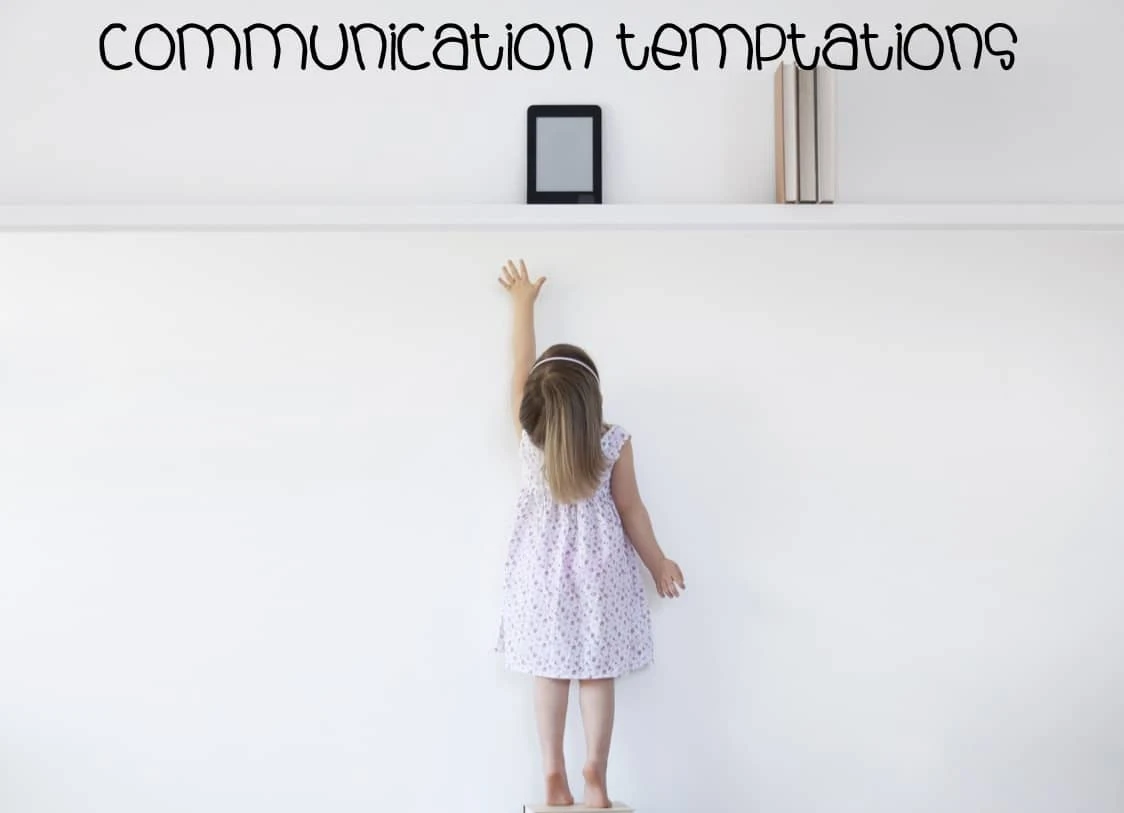
Wondering how to get your child talking? We speech-language therapists have lots of tricks in our pockets to do just that. One of our very favorites involves enticing children to talk by creating what we call communication temptations (Wetherby and Prizant, 1989).This little strategy can be used to help a late-talker start talking, to help a toddler begin using two-word phrases, or to increase the chances that a young child with autism will begin communicating.
Communication temptations are pretty much just what they sound like: we set up the environment to tempt children to communicate with us. The rationale for using them is also a pretty simple one: a child is much more likely to communicate if he has a reason for doing so!
Setting up communication temptations is easy and there are lots of ways to do so. Wetherby and Prizant (1989), who formalized the term, were pretty creative in their list of examples. They suggested things such as:
Offering your child something to eat you know he dislikes,
Putting a toy in an opaque bag and shaking it to get the child’s interest,
Putting your child’s hand in something sticky or gooey such as pudding, and
Waving bye-bye and saying “bye” as you put toys in a box three times, then pausing right before you put away the next toy.
Each of these ideas has one thing in common- the environment is set up so that a child is tempted to communicate about something (“no, I don’t want that!” “what is that?” “yuck” or “bye!”). Another form of communication temptation involves enticing a child to request. This is a great place to start for any child, but it’s especially good for kids with autism, because requesting is often the easiest form of communication for these children at first.
The steps to this type of communication temptation are as follows:
Find an activity or an object that your child really enjoys. Look for an activity that is easily stopped and started (e.g., bubbles or a swing) or an object that has multiple parts that you can hand to your child (e.g., crackers that he loves to eat, cars for a car track).
Arrange the environment so that you create an obstacle to getting that object, but so that your child can see the object. For example, put your child’s favorite crackers up on a high shelf. Or, put the cars in see-through container he can’t open.
Start the activity, have a bit of fun and then stop (put the lid on the bubbles or pull him up in the swing but don’t let him go) or give himoneitem (e.g., give him one cracker or one car).
Wait! Many parents forget this part, but it’s an important one. Give your child a chance to communicate first. Ideally, we want him to communicate without us helping him (we want him to initiate the communication), so always wait first. See what he does. Look expectantly at him, like you are waiting for him to do something (which, of course, you are!)
When he communicates with you (either verbally or nonverbally):
Give him what he wants and cheer him on–especially if it’s the first time he’s used that particular word or two-word phrase, or
What you actually do for step number five depends completely on your child and his current level of communication.
If your child isn’t yet using words, wait until he does something–anything– to indicate that he wants more (e.g., moves his body in anticipation, points, reaches); when he does (and he will!), say the word for what he wants, wait just a few moments more, and give it to him
If your child vocalizes to indicate he wants more but doesn’t actually say the word, say the word for him, wait just a few more seconds, and give him what he wants
If your child imitates the word, or even part of the word, give him what he wants and cheer him on!
If your child always imitates your words, but doesn’t say them on his own, try waiting progressively longer before you say the word for what he wants; wait for one second and then say the word, then (the next time), wait for two seconds before saying the word, then (the next time, wait for three seconds before saying the word….and so on. If he gets frustrated, go back to waiting a shorter amount of time and build up again.
If your child uses one word to request more of the item, use expansion to put his word into atwo-word phrase for him (your child: swing! you: “more swing!”), wait for just a few more moments, and then give him what he requested
If your child uses one word, you might also want to use a choice that involves two different two-word phrases (your child: cracker!; you: “big cracker or little cracker?”) and encourage him to use the two-word phrase to make a choice
If your child uses a longer phrase, but makes an error, you can correct his error by conversationally repeating what he said (your child: “wing!” you: “sssssswing!”) and encourage him to imitate you accurately.
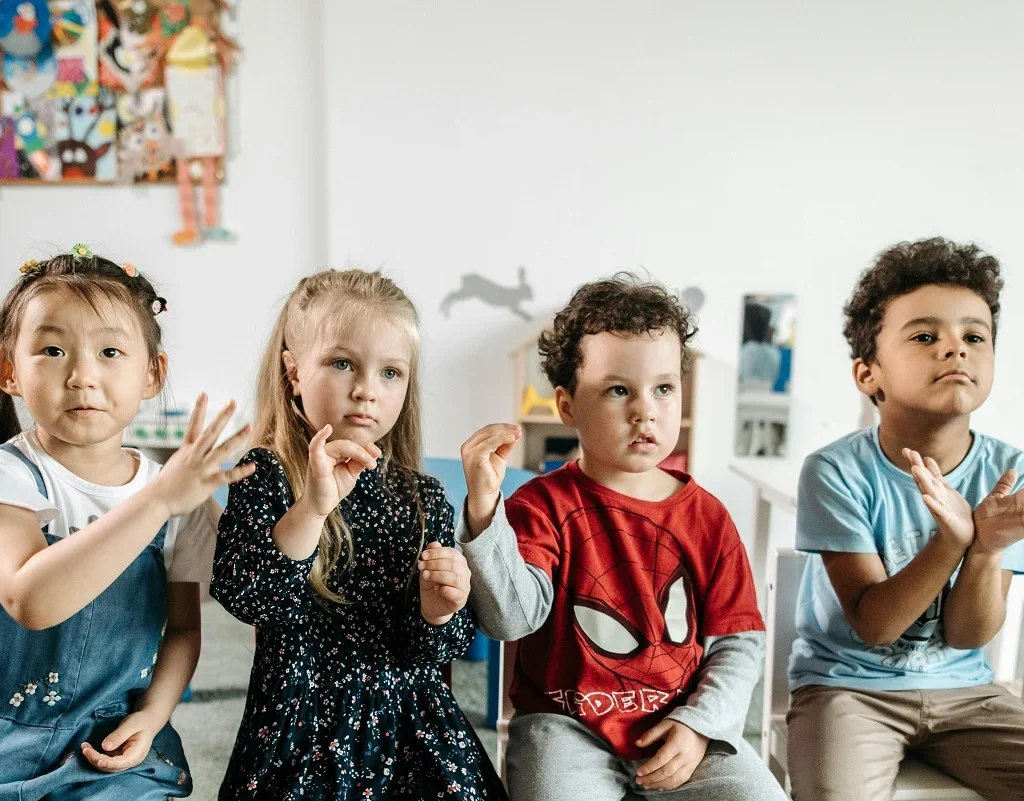
You might also think about using communication temptations to teach your child to use baby signs or pictures to communicate.
No matter what your child’s level, communication temptations are often a very successful way to create opportunities for your child to advance her communication skills. Tempt away!
It seems almost too simple to be true: To help your child learn to talk, you’ll need to….talk to your child. And yet as simple of a concept as it is, it’s also a very powerful one. So powerful, in fact, that it appears to have long-lasting effects on your child and his development.
One oft-cited research study, for example, found that the amount of “family talk” that surrounded a child was strongly related to that child’s vocabulary and their IQ at age three…and, importantly, still at age nine (Risley and Hart, 2006). This remained true even after variables such as socio-economic status were accounted for. What’s more, the type of language families used with their child was also important.
Families in the study seemed to use two types of language; the “business” talk of telling children what needed to get done (do this, come here, put that down) and the more positive, engaging, conversational talk of describing the world to their children. It was the families who used conversational talk with their children who talked more to their children….and the children in these families who had bigger vocabularies and higher IQ scores.
When I am working as a pediatric-speech language pathologist, then, I almost always start by teaching families how to talk to their kids. One of the first things I share with parents is how to use four specific types of “conversational” talking with their children: parallel talk, description, self-talk, and expansion.
Parallel talk occurs when a parent talks about what the child is doing (Eating soup. You’re eating soup!)
Description occurs when a parent describes an object to which the child is attending (Hot soup!)
Self-Talk occurs when a parent describes what the parent is doing as she does it. (Soup. Mama’s eating soup. Eat Soup), and
Expansion occurs when a parent takes what the child says and expands it by one or two words. (Child: Soup. Mom: Yummy soup!).
Simple? Yes. But research has shown that a child’s language can change for the better just by changing the language input they get from their parents. When parents are taught to use focused, simple language to describe what their child is doing and seeing, children make gains in their language skills (McLean and Cripe, 2000). This isn’t to say parents should talk in short sentences all the time, of course. Children need to hear their parents talking in longer, conversational sentences as well. It’s the balance between the short, focused language and the longer conversational sentences that seems to be the most effective.
And, as it turns out, some parents may do this intuitively. In 2005, Deb Roy, a cognitive scientist and director of MIT Media Lab’s Cognitive Machines Group, set his home up with cameras and microphones to record everything his son and his son’s caregivers said during the first two years of his son’s life. Although he expected to find that the caregivers’ language got steadily more complex as his son aged, he actually found something very different. When the caregivers talked to the baby, they didn’t necessarily use simple language and short sentences– at least not at first. But then–just as a new word was about to emerge in the toddler’s language–something changed. The caregiver’s language became more and more simple….until the word emerged in the child’s language, and then the caregivers slowly made their language more complex again. This pattern repeated itself across words and caregivers, even though the caregivers didn’t even know they were doing it. If this research stands up to time, it may show that parents who are really in tune with their babies and toddlers do a kind of dance with their child, where the child’s language influences the parents’ as much as the parents’ language influence the child’s.
It’s important to note that many children will also need additional strategies woven into their days as well: many parents talk a blue streak at their children only to find their children don’t talk back. This is by no means the fault of the parents– some children just need more help then others getting started talking. This blog touches on many of the other strategies we use to help children learn to talk, and a good early intervention professional will help parents sort through these strategies and figure out how and when to apply them. The first step along the way, though, is almost always to teach parents to use those four types of conversation speech consistently and carefully and lovingly around their child.
All of this to get at one small, yet somehow very big, idea: Talk to your baby, your toddler, your child. Talk about the things he sees, and the things he does, and the things that make him laugh. And as you do, know that you are giving him one of the most powerful gifts of all: the gift of language.